29 June 2022

doubt is our passion


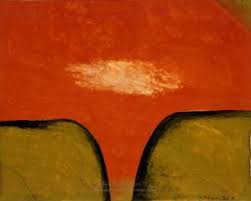
Evening Prayers, Brunswick Heads, 25 June 2020, oil on canvas board, 30 X 25 cm

This delicious study came to me the other day because each week Facebook throws up memories on a certain day of the month from years past, almost always on the same day of the month, hence, June 25 2020, 2019, 2018, etc, etc going back five or six years. It's an interesting window, a commercial one no doubt but one which I have come to appreciate over time as one can see old things anew. So, to my surprise, this one came up the other day and it really gave me  a jolt. 

Since I began this series I have struggled at times (most of it) to find something from this motif which really knocks my socks off and will carry me to the stars. To be honest, I schlep through so much muddy failure that I have sometimes felt like a German soldier stuck outside of Stalingrad during Hitler's failed attempt to conquer it in 1944. Thankfully, it's subtropical here, but failure is still always failure. 

And yet once in a while, I do manage to succeed beyond my own still obscure and yet to-be-detected visual ideas, my inchoate longings "to settle things once and for all" in this creative loop. This one study has everything I have been looking for in the motif. How to describe that feeling? I am suddenly reminded of something Henry James once said:

"We work in the dark, we do what we can, we give what we have , our doubt is our passion, and passion is our task -- the rest is the madness of art."

What I do like, most importantly, is that there is nothing in it which bothers me, there is no fault with it, all the ingrediants have come together as when a chef has created the perfect meal. Its colours are right and they are balanced in both value and hue, and these create 'the drawing' of the picture which has given us just enough of any idea to understand what we are looking at out in Nature.  And yet it is fluid so unlike a realistic likeness which, frozen in time, cannot breath into the wind nor exhale the clouds. The picture is also flattened, compressed like an excited candy bar, wrapper and all. This flat quality is everything I have been secretly coveting since finally 'seeing' Matisse only a just few decades ago. As a painter I came to him late in my life because I didn't know how to jump off Van Gogh's cliff and survive. 

Moreover, I see all of my painting heroes in this small unpretentious study. Of course, I am grateful that I am the author of it, but if I saw it anywhere, on any wall, celebrated or otherwise, I would run to it like a child does to a happy and furry dog. I just love the immediate feeling of joy in this painting. It sings, and I can say this because it is so rare that I have been able to get it right for myself. It is the feeling of surreal clouds at sunset, and for at least once in my life, I managed to get it right. And, it is not locked to the horizon line but can exist beyond it.

But I do not expect anyone else to feel the same exuberance or surprise as me yet at the same time I would certainly wish for it because for me this is what Painting is about; a communication of non-verbal feelings, not about relaying messages. I think this kind of art lives in the shade of humanism and no longer under the shadow of the Church. Today, messaging is best communicated by tweet.

Painting like any other art form is a uniquely personal experience so unlike the messaging of ideas too often shared cerebrally, almost with banal excess and without much of a commitment to any emotional investment. 

Painting and non-fiction literature have so much in common despite their different means of conveyance. A good picture is like great fiction because it’s invented, made up. And every novelist knows that fiction, like a great painting, has more truth in it than real life.


19 June 2022

rose perfume upside down


Evening Prayer Brunswick Heads 15 June 2022, oil on canvas board, 30 X 25 cm

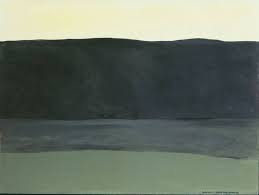
A couple of wonderful evenings of late as I rediscover the winter skies again. This past week the seas have been pale turquoise and the sky goes pink, the colour of perfume. I made six or seven studies over the course of those few days but for fun, I decided to turn this painting (above) upside down to look at it. It's interesting, with perhaps more visual logic than in its original state (below).  

One could say that what is true isn't always real, and in Painting, what is real isn't always true. But the most important thing in Painting is whether or not an image works, real or otherwise. In other words, how does it stand up to time, upside down or not.


Evening Prayer Brunswick Heads 15 June 2022, oil on canvas board, 30 X 25 cm


15 June 2022

'Twas beauty that killed the beast


Evening Prayer Brunswick Heads, June 9 2022, oil on canvas board, 30 X 25 cm

Well, well, the weather has changed, most thankfully! After I don't remember how many months of incessant rain, the skies are mostly clear, and I am again allowed to work at the beach at twilight. As we approach the winter solstice here on the east coast of Australia the afternoons close up like heavy iron doors each day before 17h. But by the end of next week the days will again grow longer allowing us more light-filled afternoons (hooray!)

When I returned to the motif last week for a string of good days to paint I felt like a novice again, a beginner as if I knew nothing. But because I love the Zen painters of Japan, I can also again love embracing 'beginner mind'. When I know too much about Painting (or anything else) I become a smarty pants, and this is deadly for any artist.

And so I approached the motif with a lot of trepidation but also with excitement too, like a young child. These four studies all came quickly over the last week. What they share is a pale turquoise sea right before the onset of dusk. Many of the other studies dig into the deep violet sea which comes afterward as the twilight deepens into the dark drama of mystery before nightfall. But these in particular have something in them which I really like; They seem to possess that incredible 'lightness of being', (to steal the title of Milan Kundera's brilliant book of yesteryear) and this pleases me, especially the one just above. I am always amazed and grateful that this motif is the gift that keeps on giving and giving, giving ever more generously. 

Of course it's the same motif I first approached five years ago, and its behaviour hasn't altered an iota. What has changed is me, because I am a better painter, because I see better now. And that is what a good and hardy motif can teach even a mediocre painter. 

Somewhere, some French painter of the recent past has said (or must have) something like the following: 

"One tames a motif over time with persistant work from it."

Could it have been Monet? Bonnard? Maybe even Cezanne or Van Gogh who might have written down such a thing but in any event, it was, and is still a modern thought. And so it occurs to me (who is a smarty pants in the end) that maybe this idea is a little backwards. Indeed, if it's even real in the first place or perhaps just a figment of my imagination from having read so much correspondance between painters over the years. But nonetheless, it does occur to me that it may very well be backwards because I have come to understand that it isn't me who has tamed the beast, but the beast who has tamed me. It is the motif which dictates what choices I make and how I will proceed because of them.  

And this reminded me of that famous line at the end of King Kong when the poor beast has fallen 60 stories to its death, a journalist remarks 

"Well, I guess the planes finally got him in the end!" 

to which the film producer responds

"Nah, it wasn't the planes that got him, 'twas Beauty that killed the beast"  


Evening Prayer Brunswick Heads, June 8 2022, oil on canvas board, 30 X 25 cm


Evening Prayer Brunswick Heads, June 6 2022, oil on canvas board, 30 X 25 cm


Evening Prayer Brunswick Heads, June 10 2022, oil on canvas board, 30 X 25 cm


01 June 2022

sloppy coherence


        Around Siena, oil on canvas board, 35 X 27 cm

To continue the idea of the last posting, here is a small study made back around in 1986 while in Tuscany on a trip. It's sloppy but there is a feeling in it which I have always liked. Most importantly though it has a feeling in my own painterly sensibility which has endured all this time. Despite its sloppiness there is the universal feeling of Siena under the dry and terrible heat of August. 

The following studies go back a few short years in this Evening Prayer series that I embarked upon in December 2017 and which has remarkably endured for five years. I include them here because they share a certain coherence with all my earlier work. Sloppy still, yes for sure, but hopefully they possess the most crucial element in Painting; that of Unity, which demands the sacrifice and the submission of all the separate parts of a picture to the integrity of whole image. It is at the heart of the French Romantic tradition developed in the second half of the 19th century. And this was my chief education going into both the 20th and 21st centuries. 

3 September 2019 oil on canvas board, 30 X X 25 cm

           
23 December 2018 oil on canvas board, 30 X 25 cm

29 February 2020, oil on canvas board, 30 X 25 cm

       28 March 2021, oil on canvas board 30 X 25 cm


29 May 2022

pondering the peregrinations of a painter


a beginning begun sometime in 2018.

The thing about creation (in practically anything) is that for me, it is about opening up to the possibilities at hand because when I do that I have a fair chance to create something interesting, something beyond the moment. I say this because it's too easy for me to lock into an idea about a painting, or a motif, and because of that I find myself stuck within walls of indecision and unable to proceed freely. 

So it's funny that in grocery shops, surrounded by colourful items, freely associating with anything I seem to think about Painting. Is it all the shapes and sizes, is it the textures and materials, the cacophonous screams of bright colours, all of which beckon me (and everyone else) to dream and desire? And so yesterday afternoon, this very thought came to me right in front of the gourmet cheese section; 

‘Just as a work of art should naturally come from somewhere, it must also naturally, and organically go somewhere also, one's work needs coherence.’

I doubt it came to me just because I was looking at cheese. But then Carl Jung might say that just as cheese comes organically from animals, paintings too, have roots, and they come organically from other paintings, at least, this was my thought anyway... Phew...

So for me as a painter, not only do paintings come from other paintings, like in a series, but also from the vaults of one's visual past in everything one has ever seen outside in museums, books, and in other's studios. An artistic life is more or less one large department store full of colourful ideas and shapes no matter what floor one finds oneself on. 


Evening Prayer Brunswick Heads, 26 May 2022, oil on canvas board, 30 X 25 cm

But more specifically, I think I was interested in how organic ideas seem to grow from picture to picture over a prolonged series of work, in my own case, these pictures made at twilight on the beach. It’s as if in a pictorial language, a personal dialect has evolved such that each picture speaks and understands all the other ones. Perhaps it’s a little like when at a large family reunion, close and distance cousins meet up with each other, where elderly aunties and uncles nod at one another with smiles from across large ballrooms, and where everyone looks for, and maybe finds, similar and recognisable traits in other family members however distant.

So coming from somewhere is established by the past, but ‘going somewhere’, is more obscure. Does it mean that the past somehow indicates the future? In retrospect we can easily see this in most every painter’s life when it’s finally over. All the twists and turns of a painter’s pictorial peregrinations are suddenly visible like on a map for the first time. The artist himself/herself, would not even remember all the decisions made to get from one place to the next, or from one idea to another. 

But what interests me equally, is that a painter’s pathway into the future need not only be coherently connected to the past, but also to the future possibilities, as if there is a window already opened by the younger version of the painter much earlier in their career. Just as an acorn becomes an oak tree, the seed of the late work is already stored inside the young painter.

Here are some Van Gogh portraits to maybe ponder, just for fun.


Nuenen, Holland, November 1884

Nuenen, Holland, February 1885


Paris, early 1886

              Paris, Winter, 1886-87

Paris, Spring 1887


Paris, Summer 1887

Paris, Winter 1888

Paris, Winter December 1888


Saint Remy, September 1889


24 May 2022

The mysterious beauty of breath


Lately, I've been thinking about how our contemporary culture comprised of both art and entertainment, have been reduced to a kind of cultural equivalency. And yes, both are big industries in the world economy, though mostly in the American one, but nonetheless, they are money-making machines,.. cash-cows, as they say on Wall Street.

Particularly, it has vexed me because as any dear reader of this tiny newsletter will know, I do not see Painting, nor many other art forms, as a form of entertainment. 

I will try not delve into other areas of this dialogue to keep it simple. But inviting literature into this discussion might help my point because I think we all accept that some books are inherently entertaining while others possess something more sacred. And ditto for music, as well as for films, theatre, and television too, for that matter. I am up for it all, though in my own case I almost never read anything to entertain myself except magazines and newspapers online where I waste too much time. 

But, like everyone today, I do watch all kinds of films and serials for many varied reasons. At tired times, when too lazy to think, I can watch the end of the world all squeezed together into a mushroom cloud but just as easily, I can be eating mushrooms with a crew of hobbits in Middle Earth. Some nights, I might tag along with cops hunting down a serial killer with a fetish for blue feet. When it comes to films and serials, my taste runs the whole gamut as they say in Tinseltown.

But I do try to discern various levels of artistic input in almost everything I engage with in life. So while I can be all over the shop in films, in music, I'm far more discriminating when it comes to Painting, a place where I take out my scalpel. 

This morning for instance, almost in a flash while playing piano, it occurred to me that this whole thing in my head was actually quite simple. The answer isn't complicated; it can be simply reduced to the idea of pathos, of mercy, suffering and death, and the compassion built into a painting through the originality and skills of the painter. But of course it also needs to be well rendered too. With these elements it will have a chance to move many of us. We, the viewers, are invited in to assist with the complicated life and death of each brushstroke. And this understanding of it naturally excludes a Post-Modern glib cynicism. 
But it doesn't have to be a kind of Vanitas of Medieval times, filled with skulls and other morbid symbols from a dark monastery. On the contrary, it could be a luminous self-portrait by Van Gogh.  

Entertainment, on the other hand, only reveals a photocopy of this experience, and though it can be deliciously appetising in detail, it is still a kind of junk-food that leaves most of us empty afterward.

I might feel nothing in front of cheap entertainment yet sometimes I can freely indulge in it too, as with the guilty pleasure of watching James Bond seduce a woman half his age. I know it's just entertainment and I know that my senses have been manipulated by the cheap thrill of it. I've been suckered in with sheepish pleasure because I've consciously given myself up to it. 

But in the world of Painting where artists compete to entertain the public is where I draw the line. Like say about Las Vegas, What goes on at the carnival. let it stay at the carnival. Let's separate McDonalds from a restaurant with a Michelin star fixed to it. A really great painting is like the latter.   

For instance, when I read a novel I want something well written, a thing constructed of wit and intelligence, something which comes to me through a wise devotion to craft. I am not interested in dime store novels or airport-reading, though there is a place for them too, somewhere I suppose. OK,... I'm a snob.


                     Piero della Francesca 

This glimpse of mortality in front of an art work is what moves me. But it isn't as easy in front of a painting as it is watching a film or an opera. If one has never wept in a movie house alongside others, one has not lived. But am I not moved by some much art because most of the artists are already dead, and they lived to tell the tale of this human experience? 


But again, tearing up while listening to Puccini’s Manon Lescaut may be a lot easier than shedding tears in front of a self-portrait by Van Gogh at the Courtauld institute yet they both evoke in us the same feelings of mercy, suffering and death. Ditto for James Joyce’s short story The Dead, from his small book The Dubliners. 

And yes, it's also in this presence of beauty too, where that very complicated word is inextricably bound up in the poet's own solemn understanding of death.

I am reminded also of Manet's late still-lives which he made the year before his death. When infirm, he quietly gave himself to a series of bouquets in vases. The fallen rose petal risks to be a cliché under less gifted painters but I think these things he made at the end of his prodigious life were his very best. There are less grand perhaps than the rest of his oeuvre but more poetic, for they are timely symbols of both life and death in one breath. Today, a still life will suffice when we remember that Nature Morte (in the French) means exactly that. 

So, contrary to entertainment, Art isn’t about ‘killing time’, it's the shadow of life folding under the last breath. And we need artists to continue to remind us of this.


19 May 2022

"Je choque donc j'existe", Andre Serrano vs Verrochio


"See, then, that bronze equestrian statue. The cruel ruler has kept the bit in his mouth for centuries. Unbridle him for a minute if you please, and wash his mouth with water."
Thomas De Quincey, British, 19 century writer

Compare these images above with the ones below of that wonderful piece by Marino Marini at the Peggy Guggenheim Foundation in Venice. It is titled L'Angelo della Citta created in 1948. A small anecdotal surprise is that the erect phallus was cast separately so that it could be screwed on and off and used with discretion. Now here is a discreet artist! He was thoughtful enough to not want to cause offence to others who might not appreciate it. This was Italy in the middle of the 20th century after all, when nuns scurried around everywhere in public. And to be honest, I don't remember seeing this poignant detail on the piece back in the early 1970's when I first saw it overlooking the Grand Canal at the Foundation. But then, those were different days because now it seems so unlike our world of Contemporary Art where  few artists would ever consider such a thing, because to shock is to affirm one's artistic right. "Je choque donc j'existe." 

I am thinking of Andre Serrano's Piss Christ, a work made to shock and perhaps insult, but also to make headlines, and lots of money.


But the statue at the top, which I equally adore, is the magnificent one created by Andrea Verrochio which sits in Campo SS Giovanni e Paolo on the other side of Venice. Its massive stone plinth is eight meters high, twice that of the rider and horse. Both this warrior and his horse exude a courageous and unrepentant power. It has always fascinated me. My father took me to see it when I was four years old when we visited one summer as a family unit in 1956. It made a huge impression upon me and somewhere there exists a Kodak photo of the two of us in front of it. 

On a light note entirely, is Donatello's statue of Gattamelata (Erasmo da Narni) made a dozen years earlier and which portrays a different side of the warrior as leader. This was the first Renaissance equestrian statue, one that revealed the warrior as an individual befitting the humanist tide of thinking which swept  through 15th century Italy. 


And here (below) is an earlier equestrian statue from the 13th century in the Bamberg cathedral of Germany. It resides inside the cathedral hall atop a far more modest stone plinth and casually dwarfed by the grandeur of its surroundings so unlike the two statues above which command the empty space encircling them both. This one is delicate, and looking vaguely lost, it is paused, perhaps in a thought of reverie, yet in remarkable contrast to the two equestrian statues above. 


It's a beautiful work and one day I would love to go see it. The rider, unknown apparently, but maybe the emperor Henry II, is unarmed and stationary unlike the Verrochio which feels almost caught in a video still of motion. I really love this piece, gentle, musing and contemplative. The horse is carved out of a stylised 13th century but much like my favorite painting in the world, The Battle of San Romano painted 100 years later in 1432 
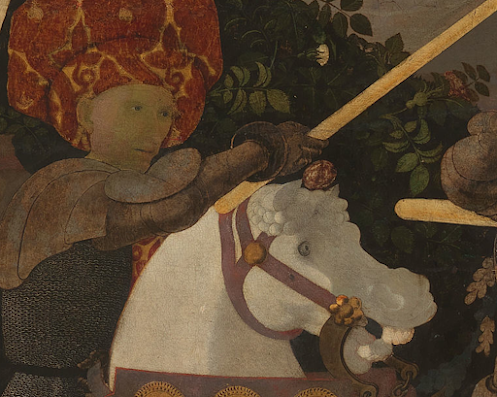
by Paolo Uccello at the start of the Renaissance. He made three versions, one is in Paris, the other in Florence, but this one below I love the most at the National Gallery in London. The humanity rendered in this figure and horse just kills me. 


And lastly here is an equestrian work from the British Museum but I cannot find any information on it. I took the photo in the Grand Court a few years back. Unfortunately, they don't have a search engine on their web site to find it but it feels like a Roman copy from the Greeks. They were adept at copies but their thirst for hyper-realism always seems to give them away. In this case the horse feels certainly better than the rider somehow. And look how much larger is the rider than the horse in this version from Rome! It's an abstraction, of course, but he is gigantic just like the way I imagine that Romans saw themselves. Compare this to the one from Bamberg where I see a rider somewhat diminutive, as if in deference to the gentle horse.


15 May 2022

Colin McCahon, cool modern painter from the cooler Southern Hemisphere


I only just recently heard of this marvelous and original painter on Radio National, the public radio station here in Australia. It was an informative interview with a curator from Auckland. I immediately went to Google to look up some images. 

Naturally, I identified with many of the images straight away through my own way of working here on the Pacific rim of civilization. He was a bit of an eccentric, like me, but a religious one, unlike me. 

The top picture has a bit of Paul Klee in it, but also Raul Dufy too.

I find his sense colour quite interesting, and equally for his sense of light. I love the graphic punch of these things here. There is a unity in his mind when he paints as if he doesn’t fuss with too many ideas; he attacks the canvas armed with an image already formed inside of him. His painting is from New Zealand which is the last land mass before arriving at Antarctica and its cooler colour harmonies reflect that southern latitude.

I have not listed the sizes because I couldn’t find them for these images on Google, which for all its greatness, is still lacking. I will let the images speak for themselves and the readers investigate online as well.