30 April 2023

boob jobs


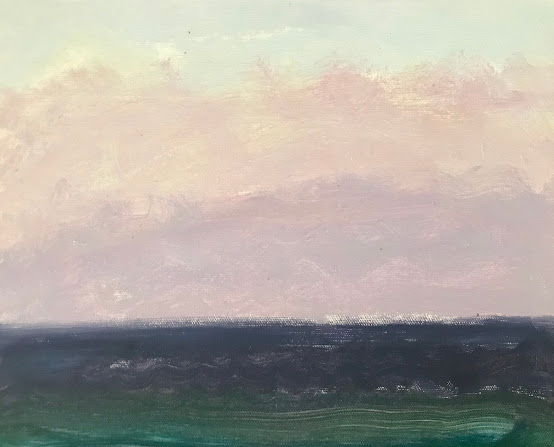
Evening Prayers Brunswick Heads, 2 March 2019, oil on canvas board, 30 X 25 cm


 Evening Prayer Brunswick Heads,2 March 2019, oil on canvas board, 30 X 25 cm (restored 15 April 2023)


Here are four images that comprise two earlier pictures and the subsequent restoration of them
both. I say restoration, but I might just say that there were properly finished at a later date because I was never happy with them the first time around. But I write restoration because they were kicking around in the back of my small Toyota for months before I grabbed them one day to 'finish' at the beach after a session. But by then they were pretty scuffed up and in need of an overhaul, more than just a boob job to make them seem more desirable.

This is a shame because I had mostly liked the 'ideas' in each of them, especially the one below which is essentially just four wide bands of colour, three for the sky, and a dark one for the sea below.

I think at the time, which was miles and miles ago, I didn't worry about 'a finish' as much as I do now. This, I feel somehow is usually the reverse of the process in a series of work for a painter. Usually at a painter's start things begin a little tight but then go crazier with later on in life. But Hey!... 

I usually stopped working on a picture when I felt 'it had arrived' at a good place in my imagination. That is to say that it accomplished the purpose of a painting session by having created an image from my imagination while using my eyes, and which I found wholly pleasurable. Whether or not that represented reality for someone else was somewhat secondary. For me the question was; Had I caught something in what I had seen? 

So although I feel the top painting, the one with the purple line of cloud stretching beneath the warm yellow band of sky was certainly finished after the initial session, I had also been unhappy with the sea. Had it been too monotonous or otherwise deficient technically speaking? In any event, I put in the boot of the car where it got bounced about and roughed up for about a year, and by then it needed to see a surgeon.  

The result of this operation changed its form and colour entirely. But I was pleasantly surprised nonetheless, and reasonably happy with it. 

This one directly below, is a shame because I had loved the way the four bands of colour expanded across the picture plane like elastic; the palest Prussian blue, then a rich (but broken) pink, then violet underneath, giving the whole sky a certain kind of weight.

To finish it, I had imagined only a small bit definition work around the horizon line that had needed cleaning up. But alas,... that too, had suffered at the hands of the boot and it too went under the surgeon's brush. I wasn't overwhelmed by the result.

Though I did enjoy this work of cosmetic surgery, I also regretted too, because I think like so many surgeons must feel deep in their hearts and behind their credit cards, that really, the boobs had been perfectly fine the way they were before surgery.  

But there are lessons to be learned all around. One, like boobs, skies, no matter what the configuration, are almost always quite beautiful in their natural state. And two, like an ex. of mine had constantly harangued me, just keep the car clean.


Evening Prayer Brunswick Heads, 11 March 2019, oil on canvas board, 30 X 25 cm


  Evening Prayers Brunswick Heads, 11 March 2019, oil on canvas board, 30 X 25 cm (restored 15 April 2023)


23 April 2023

The murder site


Evening Prayer Brunswick Heads, 11 April 2023, oil on can canvas, 
30 x 25 cm

Recently, after looking at these posts, a friend exclaimed that I was "apparently an analytical painter". This surprised me so I thought about it for a while. Then I responded.

"The way I paint is quickly and without thought, like a murder committed out of passion. Maybe I had pre-meditated it beforehand, or not, but it was still an act of speed and 'thoughtlessness'.

"Like a murder," I continued, "it's only afterward when the cops have come in to block everything out, to figure out the Who, the What, and the Why, do I go into Police headquarters and spill the beans."  

This, I explained to my friend, who then looked at me extremely puzzled. 

In Painting, it's rarely what one paints, but how one paints.  


16 April 2023

Morocco, carrots to donkeys and barking dogs


The other day I was looking at some drawings I had made in Morocco during several trips there many years ago. This prompted some interesting thoughts about those drawing trips I undertook during that time, light years away now.

They were an adventure in lots of ways, but also kind of difficult too because I was spending all my time just drawing in the streets, and in Morocco, after a few weeks of this, one can easily be worn down. I rarely did anything but draw on these trips except to visit a few museums and rug sellers of course. And like the 'economical' means with which I drew, so too, were my small hotels and cafes as well. I moved with a quiet simplicity through life there.

I drew in all the big cities, Marrakech, Fez, Rabat, Casablanca and Tangiers. But I liked Essaouiria the best for its easygoing atmosphere on the Atlantic coast, and it's where I would invariably end up each trip. 

There I got to know woman who worked at The Alliance Française which was located in a large and lovely Riad in th middle of town. This French woman had come to Essaouiria from Paris a few years earlier and she was very happy with the move. She was curious about my drawings too so I suggested that she show them to her boss for possibly a small exhibition which I knew they set up regularly. I gave her a small book to show him. A few days later we met at a cafe and she told me that he didn't think a show would work for one reason or another. But I sensed that there was more to the story so I boldly pressed her on what he had thought of the drawings. With a Parisian shrug, she confessed that he hated them. I was briefly stung by the remark but then curious for an explanation so I asked, "Alors?". She went on to say that they were too depressing and too dark, apparently.

"OK", I thought" after pause, so I let it drop.

But it did suddenly give me a shock, and it shook me out of my solipsistic and dreamy notion about myself, one quite removed from the big world outside.  

And yes, I could understood that maybe they appeared dark and depressing to others, though I couldn't be sure, because for me, they simply revealed the hard truth of what we call, The Third World. To me, they are real, "juste", as the French might say.

Of course, many tourists and visitors do not see this side because they are chauffeured around in luxury mini-vans going from one luxury Riad to the next Palace, then onward to chic restaurants all over Morocco just because they can. The exchange rates are most advantageous in the Third World. 

So I had to suddenly reckon with the fact that these drawings of mine are not happy postcards of Morocco, nor are they for everyone.

But "Hey!"... I am drawn to sorrow like a donkey to a carrot, too late to change! 

But aside from this entire previous dialogue, there was this realisation that I was sensing, I was ruminating, really, as I looked at the drawings the other day. 

What it was, was the notion that I could somehow 'see' their faces as if they were imprinted in my mind even before I had started drawing from them.... And yet these drawing were made so quickly that this seems almost impossible to imagine.

But it created the impression that I could see the specific feeling behind the face of each person whom I was about to draw, as if I had already grabbed their expression in my imagination nano-seconds before commencing, and this seemed crucial to allowing me to draw them in the first place. Whew...Wow...

Curiously though, I never really spent much time thinking about this part of the process. I just went out into the streets and worked quickly, without thinking, as I was taught by Léo, my teacher many years earlier. 

No thought, so Zen,... and yet, something in this way of working moved me enough to keep going, day after day, week after week.

So yes, they rarely look happy because Moroccans are always working like dogs, and just like donkeys, they rarely look happy. It is a hard life and I am always attracted to these forlorn lives, forever, for I am not after vanity but humanity.


09 April 2023

Easter and the Muses


I have loved this one holy moment of the Christian year all throughout my life. Brought up Catholic, though quite casually, I only knew the inside of a church like a tourist.

Much later, when I discovered the Churches of Europe I was opened up to Art through this idea of redemption and rebirth, two Christian ideas that I hold dear today as a painter.

Redemption, because I was allowed to forgive my worst enemy: Myself. And Rebirth, because I now understand in these later chapters of my life that each new day is a joy to live because of Painting, but also so much else. I am also grateful because previously this enemy wouldn't have allowed for this.

It was during my time living in France that I came to appreciate France Musique, a station that offered up a feast of Bach and Handel during this week after Palm Sunday. One can be irreligious yet still be in thrall to great spiritual mysteries that one finds in all things Artistic, notably, Chartres Cathedral but also Claude Monet in the Orangeries in Paris.

So, despite this awful cliché, I've found that flexible space between the Spiritual and the Artistic. On the one hand, I had to pass through the Spirit to become a painter, but on the other, I needed Painting to bring me to the Spirit. 

So with thankfulness, I offer up my favourite spot in the whole world over these past six years, a small dune by the sea where I come to drink from the golden chalice of the Muses. It's a good life and I am grateful. 


02 April 2023

April 1st, Trump and Obama


I cannot remember where I picked this up but it has had a place on my desktop for a while now. And what better time than to post it than on April Fool's day.

Whoever painted it has a strangely cool sense of originality, as well as a great graphic sense for drawing (and likeness). It reminds me of those fantastic paintings that adorn Barber shops all over Africa (and even in parts of inner city America brought by migrants). 

A picture like this always reminds me that for me, originality is everything. It is because it means that something is real, flawed perhaps, but real. And as originality can reveal creator's defects, it will also reveal the unforeseen assets as yet discovered deep inside a creator.

Years ago, I remember reading about the actor and painter Martin Mull whose paintings are wonderful, quirky, and yes, very original. He had gone to Rhode Island School of Design back in the late 1960's. He recounts in his book that there was a fellow student who was obsessed with Vincent Van Gogh, who wanted nothing more than to paint just like him. He showed up in class even dressed a bit like the great artist wearing baggy soiled clothes and wooden clogs on his feet, (which were becoming the rage in France when I was there in  the 1970's). According to Mull, his paintings were wild and unstructured and left the class amused and befuddled. He seemed desperate to find his own style by channeling Vincent Van Gogh. Exasperated, one day, the teacher took him aside and asked him to paint a self-portrait while patiently explaining to this student that any 'flaws' or 'mistakes' that were revealed in it were in fact going to be his 'style'.   

I don't remember the end of the story but Martin Mull certainly took this lesson to heart because he wrote about it many years later on. 

This story impresses me even now so many years later for it speaks to the truth of living an 'inside' life, not an 'outward' one. This is essential for a creative person, especially painters. And though some painters find sartorial bliss by showing themselves off in wild clothes and pyjamas, Being a 'M'as tu vu?' is dangerous for an artist. 

So in this spirit I share this curious and crazy portrait of two American ex-presidents. One, who possessed class (and style), the other one, so obviously desperate for both. One happily smiling, the other just trying to.... Go figure.


31 March 2023

Maurice Ravel and his blood brothers


Evening Prayer Brunswick Heads, 25 July 2021, oil on canvas board, 30 X 25 cm


Evening Prayer Brunswick Heads, 7 May 2019, oil on canvas board, 30 X 25 cm


Evening Prayer Brunswick Heads, 23 February 2019, oil on canvas board, 30 X 25 cm

OK, I have been looking through photos this week because I am selecting a few new images for more postcards. It's purely a vanity project because as we all know, hardly anyone buys or sends postcards anymore, alas,,, and stamps are frightfully expensive too. But hey! I do it for myself because I like both sending and receiving them through Snail Mail, (and because we only live once). 

Already, I have a series of twelve different  cards but I'll add an additional six to make eighteen which will be a happy, round number. These things are important despite what some may think.

So, I came across these studies the other day and I was intrigued with them. They probably wouldn't make successful postcards as they don't look commercially viable though I may do them anyway just for fun. I would love to imagine them stuck with funky magnets on different fridge doors all over the world.

I have also been listening to Maurice Ravel for weeks now while at the same at time perusing all these studies. And I have also been studying a small piece he wrote called Prelude 1913. It was written for students to play as part of their entrance exams into the Conservatory in Paris. As I understood it they were given this piece an hour before the exam and expected to play it before the judges in a giant hall. It's but a tiny fragment of a musical idea, just 1:15 minutes long but it embodies a host of ideas that seem to spring out of it like poppies in Spring. And like a pulse, after just a few measures into it, one can already hear Ravel's own heartbeat coursing through its bloodstream.

And for a painter this is like a fingerprint as when seeing a small fragment by Van Gogh and being able to feel the artist's handiwork within the paint.

But anyway, I still struggle to get this little Prelude right, but its among other pieces I'm learning too so it takes time. 

Over the past year at the very end of each day, I've gotten into the curious habit of playing this Prelude 1913 before getting into bed at night. It's the last act before sleep, after I've locked my doors, shut off the lights and brushed my teeth, I'll sit at the piano, conveniently situated on the way to my small bedroom. There I run through it a few times while reworking small passages here and there that are problematic. I know it by heart of course, but knowing it well, isn't playing it well. It's a fragile piece and it needs a delicate and a soft touch, something I feel I've never had. I think I wear a catcher's mitt on my left hand.

But anyway, Ravel has a way of getting under one's skin and into one's nervous system. Music appears to do that to everyone. Indeed, I think all of humanity sings a billion different melodies all at once. It's one of those distinctive things that make us all human even whilst under the worst of circumstances. It's a lot like laughter. 

Ravel's mellifluous harmonies, like certain kinds of large paintings by Emile Bonnard can also infect one's soul in a particular sort of way, as say, Picasso or Gershwin might in another way altogether. 

Ravel's music, like many in the Romantic tradition, is infused with emotion. It has been criticised by some as being "too sweet", perhaps too "impassioned" or "sentimental". But "Sacré Bleu"! I say,,,, though I can see what they mean when compared to Debussy with whom he is mightily compared. But I don't care, as with apples and pears, I will eat both. And I will always be aligned with those of great feeling in all things Artistic. A Robert Wilson fan, never,,, but Mahler, yes,,, forever.

That's the way I am, and the proof of this is in these three pictures above for they are exercises in pure sensuality. 

Ever since I was a kid I only ever wanted to play with anything that made slurpy marks, anything at all,,,, gravy and mash potatoes on my plate, mud puddles on my way to school, then finger-paint at school and everything afterward. Working in oils was the stepping stone to real Painting, and into the Renaissance of my father's art books.

Yet the personal obsessive question for me has always remained the same;.. and that is:

How do I convey this emotional feeling through Art? If I am not attempting that then what the heck I am doing?

So for me, like Ravel's music, these three pictures are constructed as a bridge to the human heart, to feeling, but not to sentimentality.


25 March 2023

Darn! some daze, it's nothing but questions!


Evening Prayer Brunswick Heads, 22 January 2023, oil on canvas board, 30 X 25 cm


Here are some recent studies which prompted a few thoughts for me to contemplate. 

Firstly, I was thinking that from the very earliest brushstrokes, when beginning a picture, one problem is already present. This problem, like for any novelist or filmmaker, is about how to move coherently towards the solution to end each picture. But indeed, this solution is already linked, inchoate, to every particular individual part in the making of the picture. 

Secondly, how do I paint an image which is so personal and so specific and well-defined, yet not too myopic or solipsistically personal for others to feel and perhaps appreciate?

Because Painting can be such an immediate and emotionally charged art form, it often evokes unique and visceral feelings for different kinds of people. Indeed the world of Art often feels like a wild and untamed Pacific Ocean of creative juice to me. So, how do we, as painters, transcend our own bubble of experience, rendering it poetically communicable to others? Or do we just say,
 
"There it is, tough shit if you don't get"

So thus, how do we as painters (like great novelists), create a 'fictional world', one within this constraint, and one that can be  cleverly exploited to fully express what we need to express, not just to ourselves, but to others as well?

And if so, how do painters visually communicate? Are we communicating an idea or a feeling? And which is better? Are they the same, or not? There are always so many questions! Too many, really,,, enough to make one crazy when one is just sitting around looking at butterflies and not working..... but questions persist.

If a picture doesn't work for a viewer, is it because the painter fails or because the viewer does? And if it's the painter's fault, is it because it's a poorly-made picture due to his/her technique, or is it just a poor idea?  

But what indeed is a poor idea? Is it one that communicates only a 'photocopy' of the original motif (or idea?) either in one's own imagination, or taken out from Nature? But these are different sources and they can create different problems. 

But if the viewer is at fault, (is this even possible?) is it because they plausibly do not do not have the knowledge or experience to understand a painting? In this case, one could certainly imagine a violinmaker explaining to an amateur the virtues of his newest creation. 

But pushing this question further (as an obsessional naturally would) ask if an idea, for instance, is born from a visual memory or a conceptual rumination? Is an idea born from an experience of using one's eyes out on a motif with the aid of one's memory? Is this what one might would call a visual memory or is this what one might call direct contact with Nature? Is this plain-air painting? (I really detest this expression though I am not sure exactly why).

Ouch, too many questions this week!

But anyway, these three are from January. I liked them then, and still do over a month later. I remember these two below quite well and I see that I was pursuing my persistent obsession of making a flat image from this three dimensional motif out in Nature. On some days this idea is stronger than others because some skies naturally lend themselves more to this idea while others hold onto their more anecdotal elements and render them more 'traditional'.

The one at the top I also like because of the drip of paint inadvertently confusing what could be called the 'drawing', adding another question to the whole darn thing!


Evening Prayer Brunswick Heads, 18 January 2023, oil on canvas board, 30 X 25 cm


         Evening Prayer Brunswick Heads, 18 January 2023, oil on canvas board, 30 X 25 cm


27 February 2023

Fractal secrets shared in front of the hearth


Evening Prayer Brunswick Heads,17 December 2019, oil on canvas board, 30 X 25 cm


Evening Prayer Brunswick Heads,17 December 2019, oil on canvas board, 30 X 25 cm


Evening Prayer Brunswick Heads,17 December 2019, oil on canvas board, 30 X 25 cm


Three studies that were all made on the same evening, one right after the other. And now looking at them a few years later on I see three step sisters ready for the grand ball. But then my imagination is both eccentric and historic. Anyway, I came across them recently in a file and I liked them immediately as a trio because as a painter, it's the delicacy of these clouds that excite me. 

There is a certain kind of cloud that appears in a particular sort of pale sky, usually with a bit of humidity in the air that evokes all the lacework done by millions of women all over Europe throughout the centuries; rich and poor women, the sisters and nieces, the hired hands and the dilettantes too, all of them sitting around the hearth and sharing of secrets.  

And these small shredded clouds, like secrets themselves, are fragments that dissolve into thin air during the tumid moments before dusk swallows them up like a giant whale in a fairy tale. On the beach it's a marvellous light, and a gentle one, unassuming too, one where ancient secrets speak to weird painters and drunk poets, small dogs and wild children romp deliriously into twilight.

And these are the types of clouds which take me to Painting. For a long time I have thinking about how pieces (or planes, if you wish) of a whole painting are fastened together one to another. I know I have spoken about this before but not in a while. 

A scientist from Scotland whom I met at in Comps, near Dieulefit one summer evening years ago, urged me to read about the Chaos theory and suggested I read a great book aptly titled 'Chaos' by a NYT science editor which I ordered and quickly devoured. It's all about fractal connections (and disconnections) but measurements too, and it traces the history of this new thinking which sprung from a few eccentric scientists working on the Atomic bomb in Los Alamos in the late 1960's (L.S.D. was also involved). But anyway, I have always been frustrated at how mathematics rounded everything off to the nearest .0. It drove me crazy. Even as a small boy looking at the sky I understood empirically so, that infinity was ever-present all around us and that nothing could be nicely reduced down to an even and perfect equation. Like many children I used to watch clouds endlessly as they swirled across the sky, appearing and disappearing, cartwheeling and somersaulting into one another like in a painting by Vincent Van Gogh. Clouds, like everything also in the plant world, was one of the easiest ways to witness the fractal behaviours in the Universe. And so, for me, when painting certain cloud shapes in the sky, the fractal connections manifest immediately.

The importance of how planes (and shapes) connect to one another is an essential element in Painting. But also in all Art, Architecture, Music, and, as a girlfriend once advised, in love affairs too. Every painter has to deal with this whether he knows it or not. And moreover I should say; whether he or she is conscious of it, or not, for I can see that lots of artists do not seem to place an importance upon it. And yet, they are still constrained by its importance nonetheless, for the successful unity of a painting is always still grounded in how the sum of its parts click into each other like Lego creating an energetic whole.

Of course the subject matter in Painting is extremely varied and uniquely different. And it is made up of so many physical qualities of materials that also deserve different treatment; the skin, bark, stone, wood, glass, flora, hair (human and otherwise), and the air itself, the most popular element that holds so many pictures in its light grip. In a unified painting, all these diverse materials desire to be connected to one another with great subtlety. Painters of every Age in history had to learn the delicate craft of bridging these often disperate elements on a picture plane. 

In the popular genre of landscape painting these various bits of fractal foliage equally work to attach different elements of a picture together one to the other; the fields to the trees, the hills into soft mountains, the chimney smoke into the air overhead. In landscape their tactile logic is terrestrial. 

But these studies are mostly concerned with painting the sky which is ephemeral. In the end, it is basically just coloured air and gaseous clouds that require a deft but patient hand.

Whether one looks at an 18th century marine-scape from Holland or an abstract 20th century work by de Kooning, the unity, or lack there of, is cemented by the manner in which each brushstroke of paint, both literally and figuratively, attach to one another. 

The really, really great painters do this extremely well, whereas all the others seem to limp along awkwardly in uneven circles. 

So I hope that these three studies above, whether limping, or in a 'Gavotte', reveal a tiny fractal system at work in some fashion or other, successful or otherwise. 


18 February 2023

Five paintings, the air but not the wind


Evening Prayers Brunswick Heads, 18 January 2023, oil on canvas boards, 25 X 20 cm


Evening Prayers Brunswick Heads, 18 January 2023, oil on canvas board, 25 X 20 cm


These are all from one evening about three weeks ago. For some reason I decided to try a mini series on small boards, I think because I hadn't been out to the beach so much, and maybe I was feeling unsure of what I was going to do. Of course, I am never really sure what I'm going to do anyway until I begin mixing a palette. Tiny ideas bubble up like water when I prepare my colours and they begin to match up with what I'm starting to see in the sky already. But I rarely have an idea until the last minute because I don't know yet what the sea and sky want me to do. But they usually need a human sacrifice first, and it's always the painter, meaning ME, in this case.

So on this evening which was showing great promise, I set up and began to patiently await signs of life in the sky, wondering just what it would dictate for me. 


I had made the decision to work quickly, to try to find something simple to grasp onto, to capture it then leave it be. I'm like a lepidopterist who captures a butterfly in a large soft net only to let it go after a brief but intense inspection. 

I think it was because during those few days I was still thinking of that small Turner watercolour of which I wrote about a month ago. Images like that can take up lots of space in painter's head the same way as a melody in a musician's. This evening I wanted to keep them fresh and not get bogged down into laboured paintings, I wanted some delicate studies; I wanted the air, but not the wind. 

And so these came out of that evening and I was reasonably happy with them. I believe they are in order of execution. The last one at the bottom is actually a slightly larger canvas board, so by the fourth study, I must have been feeling more confident.

The first one was very compact, barely a breath of a thought, but I really like the way the sea came out, it was almost sliced in two and creates an unusual foreground almost like throwing a silk scarf around a wool jacket. 

These kinds of spontaneous decisions whilst painting are more natural to my process than to many other painters who might exercise more thoughtful care than me in front of a motif. After all, I'm a remnant of another tradition, one more casual than dour. But that said, I do like detail, but details are just nuts and bolts which fasten a structure together. Imagine Uccello's grand picture, The Battle of San Romano, in the National Gallery of London exhibited in someway close to a jet engine. (now that would be a fantastic piece of Conceptual Art).

In any event, the second painting became a little more involved as I became more entangled  with the sensuality of the paint like an artist from 18th century Holland.

The third one (here below) was also done quite quickly, it felt rushed, as if I wanted to get through the meal in a hurry, getting to the  desert even faster. And it even reminds me of a plum tarte, a Reine Claude, made in the late Autumn countryside of France.

The one below it (middle), is perhaps my favourite as it too came quickly, but with also  a real feeling of getting what I had desired out of this sky, not scratching haphazardly for an answer, but moving without hesitation to its resolution like a trained dog looking for survivors.

And lastly, the large one at the very bottom, is a depiction of when the sky has just peaked and feels mellow like a large hot air balloon releasing its chamber and slowly returning to earth.


Evening Prayers Brunswick Heads, 18 January 2023, oil on canvas board, 25 X 20 cm


Evening Prayers Brunswick Heads, 18 January 2023, oil on canvas board, 25 X 20 cm


Evening Prayers Brunswick Heads, 18 January 2023, oil on canvas boards, 30 X 25 cm


14 February 2023

punished and sent to bed without dinner!


Evening Prayer Brunswick Head, 16 January 2023, oil on canvas board, 30 X 25 cm


Three dark pictures, taciturn, like naughty children who were punished and sent off to their rooms for misbehaving. They are not happy about it! In fact, they remind me of ME, when I was punished and sent to my room without dinner. Whether we like it or not, it appears that our past will always keep sending us postcards from places long ago that we would rather forget.

But these three were done on a rough and stormy-looking night. In the late afternoon I had driven out to the beach because the sky had looked decent from the house, but darn it, Mother Nature fooled me as it often does because it was overcast. I had had misgivings already when I hit the road and saw the dark sky but, "what the hell", I thought, I had been home all day and wanted to get out. After a ten minute drive I arrived and parked carrying my painting gear up the sweet little path about 60 meters further on to the small dune where I normally paint. The beach was windy and desolate but I set up anyway. My outings there had been sporadic all summer long due to the weather and I really missed these afternoon sessions. 

Though a bit confused by the form of so many clouds all jumbled together into a flat pile, I nonetheless jumped into the first painting above without too much thought and I quickly lost my way,. .. Ha Ha,... and so much for rigorous restraint. Remarkably though, I was able to 'bring it back' and save it by turning it into something I had not at all anticipated. It's now not at all unpleasant but just something very different than what I had had in mind. 

In fact, though surprised, I was reasonably happy with it, but the weather discouraged me from beginning another one from this dark and difficult sky. So I brought out two older studies which I had brought to see if I could also 'bring those back from the dead' and perhaps put them into an acceptable state.  

But there is something about these two older paintings (below) that make them somewhat unusual. When they were done (years earlier) they were not quite right, either just plain boring or perhaps just 'unfinished' or 'unrealised', which was what I actually felt about them. But anyway, they were unacceptable and worthless to me in their present state. No drama, this happens all the time to paintings. Often, paintings will either get better with time or worse. Unlucky paintings might appear great when just finished but over time they quietly fall off the podium and end up in the leprosy ward. Still others might look awful when just painted but improve with age like a bottle of whiskey. It's really out of our earthly hands, and as any artist knows, the Gods regulate all this stuff in the end.

But these two were rather mediocre, somewhat lifeless from the get-go and whether as Dr Frankenstein or Doctor Good, my desire was always to give them a life of their own. 

So over the past few weeks I have begun pulling these poor things off the shelf a few at a time and putting them into the boot of the car with the rest of my painting gear. When I have finished a session and my palette is drenched in colour, and importantly, if the skies seem to vaguely line up with an idea, I will put them on the easel, look at the motif, and throw colour at them to see what comes of it. What is that expression for politician's behaviour so prevalent on CNN roundtables these days? 

"Throwing spaghetti on the wall to see what sticks?" 

After all, I have nothing to lose. Sometimes I pull it off while at others it's a lesson in exasperation. 

But Painting is not a zero-sum game as many seem to understand the rest of life to be, (mostly financiers to be honest). Still, the native American Indians (who are still a wise bunch) often quip: 

"Sometimes you eat the bear, and sometimes the bear eats you". It has nothing to do with a zero-sum game at all, its simply bad luck.

In any event I am reasonably happy with the first painting below, though there is that bit of scruffy-looking light on the righthand side that I might still tone down ever so gently if I get to it.

But I am really happy with the one below it, for it came out just right, to my complete surprise. And it was ALL just good fortune, really good luck, because this time around, the E.R. doctor inside me managed to revive this cadaver. But I have no idea how I did it. It happened so quickly, perhaps within ten minutes. It was done like in a dream that one quickly forgets upon awakening. It comes at the surprise end of a long trek home.

There is much to say about all this but it will have to wait for the next time to go further into this subject of what constitutes the idea of 'Finish' when considering a painting. 

Anyway, I always learn so much by going deeper and deeper into a picture, almost against my own instinct, like a cave inside myself, deeper and darker, until I feel as if I am back in my childhood bedroom again and still being punished without dinner.

 
Evening Prayer Brunswick Head, 16 January 2023, oil on canvas board, 30 X 25 cm


Evening Prayer Brunswick Head, 16 January 2023, oil on canvas board, 30 X 25 cm