31 March 2022

Thomas Aquinas at the Pharmacy


At some point in my otherwise mundane morning of running errands at the pharmacy, it crossed my mind while waiting at the counter that we all need Greatness in Art because without it we have no guidelines, no markers to judge Art. And I am speaking of an Art of equally horizontal and vertical means. 

Without Greatness (decidedly with a capital G) we are like voyagers at sea on a cloudy night without the North Star guiding us. And I know this may sound quite strained to point out but I fear that this cannot be underlined enough.

And in the sphere of politics and leadership it is also indeed relevant. Look at the invasion of Ukraine by the dictator of Russia. This is as much a travesty of human behavior as is an atrocious work of Art. I do not understand why journalists and politicians in the West call it a war, for it is an invasion, a war is declared by two, (or three parties). Ukraine never declared war on Russia but it defends itself like a small Morandi in the corner of large museum wing.

So what is Greatness? In Artistic terms one can think of what Thomas Aquinas wrote regarding Art way back in the 13th century.

“Art is the measuring stick for Art”, he wrote.

It speaks volumes of the whole big damn sky of  everything under the Tuscan sun, and yet, he declared nothing more or nothing less with such acute brevity so many centuries ago. He means that Greatness will dictate Greatness as sternly as quality begets qualityBut we have to understand Greatness and quality first. And for that we need an education, in this case an education in Art.


And what happens if we lose sight of it and we get lost? Like maybe getting on the wrong train to somewhere other than where one intends. Or, getting on the right train but suddenly thwarted by thugs or terrorists even? 

What if this derailment begins, like in a game of Chinese Whispers, as Greatness only to end up as Suffering Suckatash at the end after having going around the dinner table? This is what happens when education fails us and disintegrates leaving its roots to rot away over successive generations. It becomes the Blind Leading the Blind. And if you don't believe me, look around at any Art school.


But what if, through Capitalism itself, Greatness just slinks away from the table altogether when money is disguised as the arbiter of both Greatness and Quality?

What happens to us when we no longer know how to recognize a really good book because we have forgotten how to read one? And what about Painting? Have we forgotten how to look and feel, just because we have forgotten how to see? 

And what happens to us morally when we fail to act against tyrants even if we have been tyrants ourselves in the past?

All this went through my mind whilst waiting for my prescription to be filled at the counter this morning.


27 March 2022

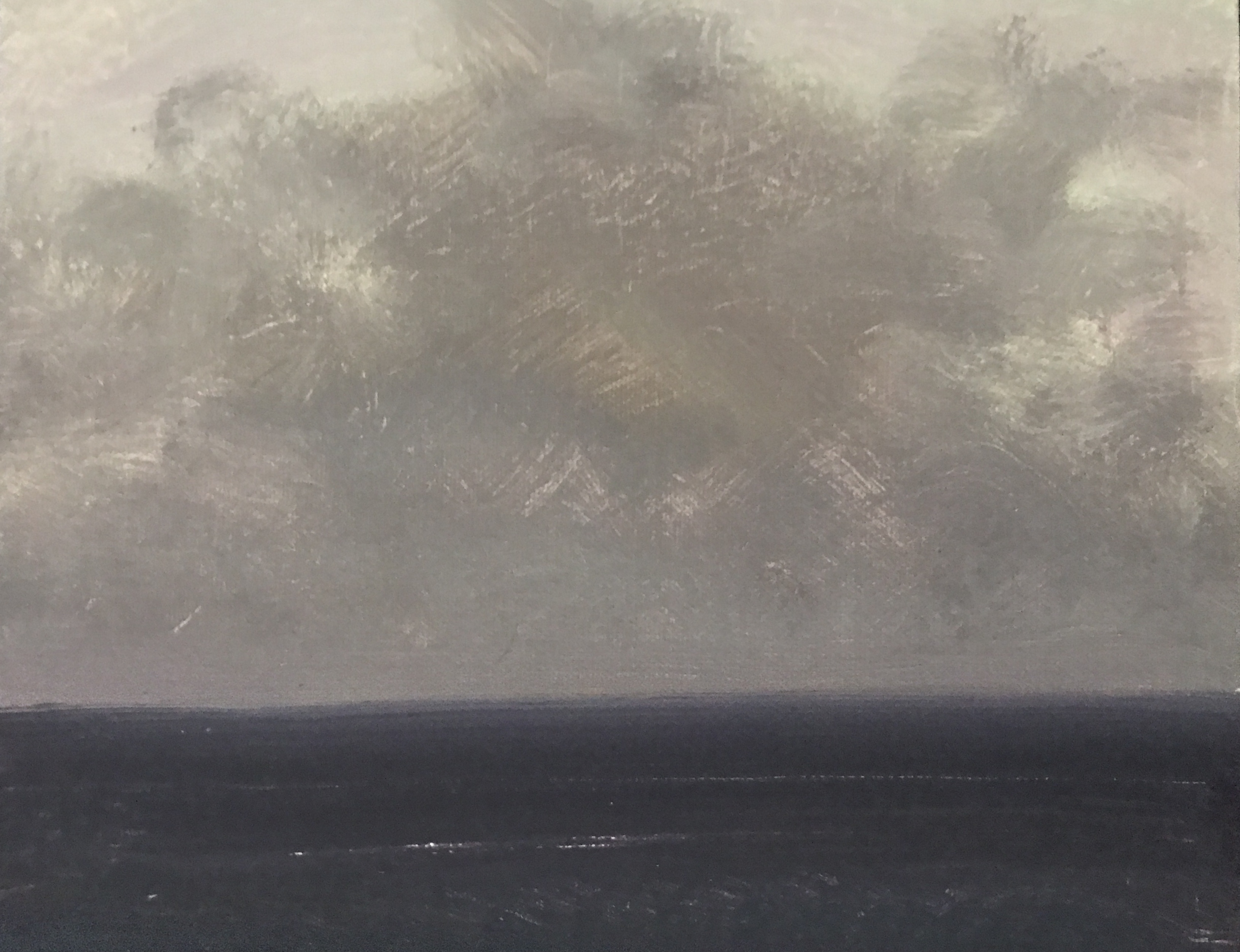
three sisters at dusk


                      LTM                                                                          
Evening Prayer Brunswick Heads, 16 March, 2022, oil on canvas board, 25 X 20 cm

                                                                          LTA
Evening Prayer Brunswick Heads, 1 March, 2022, oil on canvas board, 25 X 20 cm

                                                                           LTN
  Evening Prayer Brunswick Heads, 16 March, 2022, oil on canvas board, 25 X 20 cm

Three recent studies on successive nights though something doesn't quite add up as the skies look too different. Well, I will let the accountant sort it out when I die.

I was really happy with the bottom one. I was when I painted it and still am thankfully. It speaks to an emotion that I often feel in front of such clouds just after dusk when everything lightens up a bit, softens and the colors diffuse with a gentle elegance. 

The middle one was a bit of a surprise because generally I avoid these types cotton candy clouds by waiting them out. But this time I jumped in like a small child at the county fair devouring what I could as fast as I could. 

The top one is simple, perhaps a little facile because I really wasn't inspired by it. Ans not having been out too much due to the weather, I felt a desperate sense that I needed to DO SOMETHING, anything at the beach in fact. So, it is a study of the sky in the simplest of ways.


26 March 2022

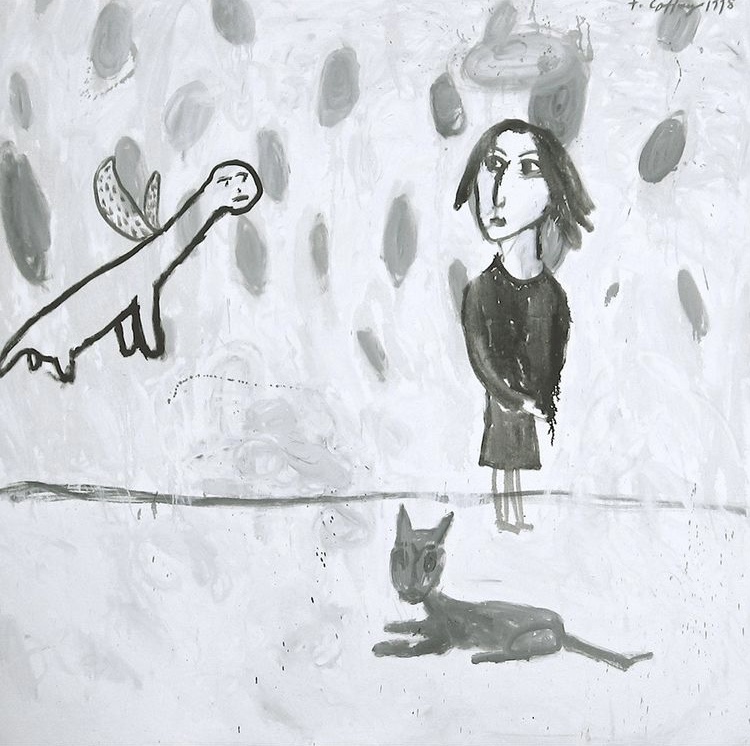
Because we need miracles in this time of Putin madness.

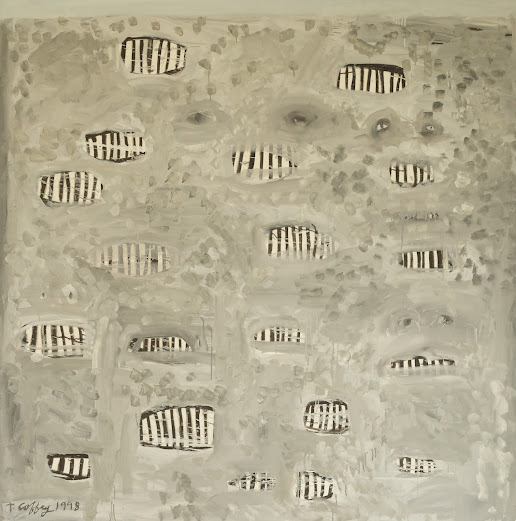
  • Annonciation, Chateaunoir, August 1998, oil on canvas, 150 X 150 cm
This painting came to me as if in a dream and I quickly put it down as a sketch but then liked it so much in this state that I left it as is. And for that, I am grateful for I have destroyed hundreds of paintings by trying to 'finish' them, making them 'better'.

In this time of Putin madness there is indeed a need for many miracles. Like most everyone else who is rational and somewhat Humanist, I am appalled that this is happening in Ukraine. But then, there are so many places around the globe where such irrational violence explodes that one can feel helpless. The war in Sudan still rages and refugees are the first victims. But there is also Aleppo destroyed a few years ago, and Myanmar, Chechnya, etc etc... It's all 12th century madness, and needless, all of it.

I will not bore you further with my own disgust except to say that I only wish the entire 'West' might have risen up to condemn the United States invasion of Iraq, just twenty years ago with the same vigor with which they have deplored the Russian invasion into the lives of the peaceful people of Ukraine. Bush, Chaney, Rumsfeld, Wolfowitz, and so many other hardcore American imperialists never faced any consequences for what they did to Iraq. 

And so, this simple picture is about a miracle, an inhuman kind of miracle, because Humankind needs more than a human answer to this life. 


15 March 2022

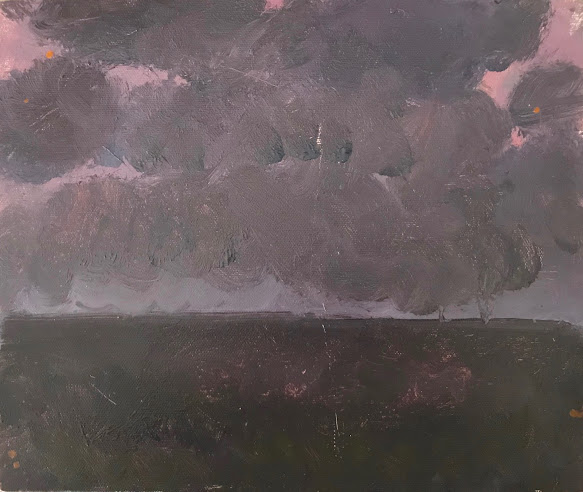
fairy tales forlorn


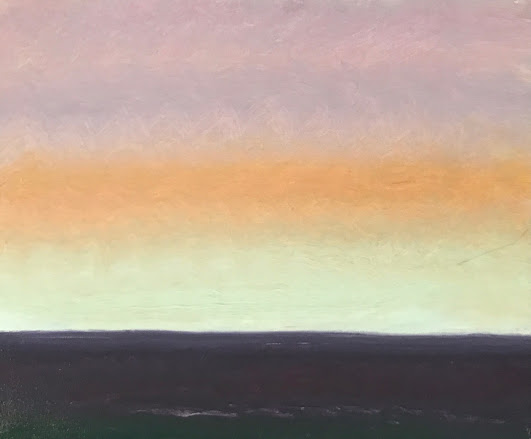
This study was done sometime in 2019 and I probably didn't like it then when it was painted but I see it once in a while while looking for paintings in the photo files. I understand now that it is something remarkable for me and thankfully I don't worry about what others think of it.

The skies have been very tormented and full of water over the last few months. It's a sky that is difficult to 'get' which is why I see something special in this one. I got it, something anyway. It works, and probably took 15 minutes or so, maybe twenty at the outside. And yet it expresses everything I feel in front of a sky like this. And because it was done so long ago, (relatively speaking) for a painter's life is measured in dog time; at ten, they are already old, so a picture made three years ago is mature, and this does allow me distance to judge it fairly.

But it isn't just the feeling of the tormented sky but also the brooding dark sea that I freely appreciate. It is the way that both the sea and sky seem to be glued on very same plane, flattened like two dried flowers and compressed into a book of fairy tales by a young girl who locked them in a coffin between two pages. 

Honestly, I think it is one of the most successful things I have made in this series. Though it wouldn't appeal to a mass public, other painters might see something in it. And I secretly wish that I had the formula to make others like this today because I feel like a beginner again.


13 March 2022

Life on the fragile lawn


What is it about the Russian war on Ukraine that grabs us all so viscerally here in the West?  We haven't gotten too worked up about what Putin has done in Chechnya or in Syria, or for that matter in the Sudan. I am not trying to blame any of us but the question keeps coming home to me over the past two weeks. 

I think it's because these are Europeans who are being bombed, and refugees are trying to escape it all like ants over the lawn at a kid's picnic party. It's close to home, too close for us, too close to WW2. 

And also, maybe this digital world of today opens up wide lens to reveal a life, for all living things on earth, to appear so unbearably fragile. At any capricious moment, missiles from afar could rip everything from us, our neighbours, our pets, our homes, both modest or spectacular, the churches and theatres, all our cultural history in bricks and mortar are split apart in a mere instant.

It isn't just man's beastly behavior, but Mother Earth's too, for she can wreak similar destruction upon all living things. Eclipsed by the War in Ukraine is the Decimation of whole towns on the East coast of Australia by flooding. Floods heights never seen before have left thousands of families homeless in the past two weeks. Because of the War no one elsewhere was aware of this disaster, otherwise it would have been bigger news for those in the Climate Change milieu or elsewhere. 

In any case, humans are in just as fragile a place as ants on the lawn, but with less organic wisdom I think. My apologies to the photographer whose name I don't know, who took this amazing image in Lismore last week. 
(Addendum, photo by Kirran Shah)


09 March 2022

The wounded sea


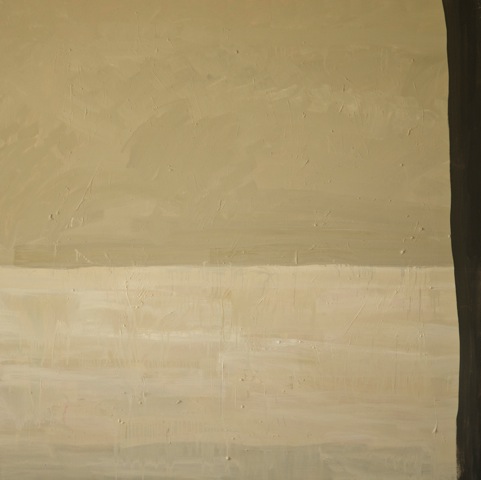
The Wounded Sea, 2012-2013 Poët Laval, oil on canvas, 150 X 150 cm


This is painting from 2012-2013 when I had a large studio in Poët Laval which is land-locked and about 150 km away from the Mediterranean Sea. I made a series of these pictures and as they evolved I realised that they were about the dying sea. I often went for swims when I went down to Marseille or Cassis to see friends. On one particular trip just off Marseille on a rocky promenade at the end of an ally way within the city friend took me down for a swim one evening in late June. I was horrified by so much litter everwhere, broken bottles, plastic cups and what not everywhere on the large set of flat rocks. And yet being a Friday evening there were lots of locals making picnics and spread out over the rocks. The red sun was sinking gently into the sea to the West. Rosé and beer were being consumed. Cigarette butts were everywhere in various states of decays and broken glass too. I found it depressing. We jumped into the sea and swam out a ways but the refus seemed to follow me. Plastic bags like colourful and large jelly fish were floating everywhere around me. Though the view back up to the buildings on the Corniche was picturesque at sunset the water was filthy. 

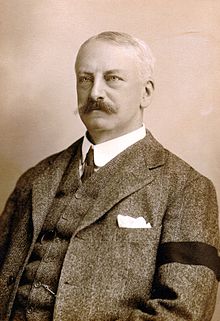
At home a few days later I began making these images, abstract in a certain way but realistic in my own mind. Many of them are accompanied by a thin black strip running up one side of the canvas. People have asked me what is that about? For me it was a way to set off the light in the rest of the painting but also represented the black armband that in olden days long gone, People wore them on their sleeves to mark the mourning after the death of a loved one. In Italy and in my early days in Aix I often saw men and women wearing them in the streets, in shops and cafes and it was fairly commonplace. But I had never seen them worn in America although they certainly were. Here, Franklin Delano Roosevelt wearing on after the death of his mother. 


Her too is Elizabeth Stuart, Queen of Bohemia wearing one in a portrait from 1614.


And below, a British physician Richard Norris Wolfenden wearing one in 1905. 


But here in Australia there is a larger historical debate about culture in Australia at the end of the 20th century. The "Black Arm Band" debate concerns the issue of whether or not the History of Australian's founding were based on fact or fiction. Many scholars believed it was fiction so they wore black arm bands to protest the "fictional" views promulgated by so many politicians on the other side of the aisle.  

And so in this picture, among a few others done at the same time, I turned to this idea to find a graphic symbol to complete my thoughts about the wounded sea around us.


22 February 2022

Pierre Bonnard est un ange qui me surveille de loin


IDB
Evening Prayer Brunswick Heads, 10 February 2022, oil on canvas board, 30 X 25 cm

                                                                                     ILM
Evening Prayer Brunswick Heads, 10 February 2022, oil on canvas board, 30 X 25 cm


Here are two studies from last week which were both made the same night yet feel quite different from one another. The first one I painted is on top, while the second study arrived along with a red curtain of dusk 20 minutes later. 

Lately, I have been struggling with finding my way into 'something new'. Like a kind of writer's block I think. The only answer is to persevere and to remember that one cannot give up before the miracle. And this is a truism for me but at the same time there are ways to freshen things up in this solitary line of work. While it is wise to keep at it in a disciplined fashion, there are ways to shake things up at the same time. So I have cleared an area in my studio and have separated lots of older pictures which don't quite excite me. It's usually because they are boring for one reason or another, or they lay around my house in a state of limbo like bored teenagers because I haven't had the courage to paint over them to begin again. 

So, on the better ones I've started adding touches of colour, patiently looking for a way into them in hopes of finding an answer from the distance of both time and space. I am looking for the penultimate ending, like for a writer at the end of his/her novel. 

And all this, of course, makes me think of Pierre Bonnard, the King of Patience, himself! Apparently, he worked on canvas's tacked up on his studio walls for months and years on end. He painted (I believe) with a painfully slow deliberation as if Time itself had slowed down to a crawl. Really great things in art possess that awful cliché of 'timelessness', but it's true. Once a successful artwork lives, it lives forever; music, books, architecture, poems, paintings, they are all created in their own time, only to then live on in eternity (and as my cousin Frank in the Bronx always used to complain, what can you do about these clichés anyway, huh??) 
 
But then, this also leads me to some of Bonnard's famously discreet but brilliant things he said in letters to friends (which I have quoted several time already in these pages over the years). Here are a few which I read continuously through in times of difficulty in my own work. I hope your French is good.

"L'oeuvre d'art; un arrêt du temps" 

"Ce qui est beau dans la nature ne l’est pas toujours dans la peinture. Exemples : effets de soir, de nuit"

J’espère que ma peinture tiendra, sans craquelures. Je voudrais arriver devant les jeunes peintres de l’an 2000 avec des ailes de papillon.

J’ai une palette. Mais les assiettes me permettent d’isoler les tons, tandis que la palette a le défaut de proposer, de les imposer, et c’est un danger. Ce sont des choses que l’on n’apprend que très tard. Ce serait trop facile de se mettre devant un paysage, de l’observer et de le transposer simplement sur la toile. Il faut encore songer au lieu où les toiles seront ensuite regardées.

Élément étranger : souvent le blanc pur ou le noir.

Il y a une formule qui convient parfaitement à la peinture : beaucoup de petits mensonges pour une grande vérité.


17 February 2022

lambs and things in the trucks on the highway


Les moutons dans les camions sur la route 1996, oil on canvas, 150 X 150 cm


This is a curious painting from 1998 when I was in the small studio at the Châteaunoir. I was working out in Nature but also in the studio, something I do today in Australia. I haven't eaten red meat since 1980, I stopped within weeks of Reagan's first year in office. That is the marker because in his first year in office he signed a bill to allow cattle farmers to use steroids in the animal feed while he, himself, kept his private herd organic. The mother******! But at the same time, I have had in my blessed life a Vegan friend who didn't eat anything "that would try to get away from him" as he put it, nor would he wear anything leather. He was a great influence upon my thinking.

I had flirted for years with the idea of giving up meat but I guess I saw this as my final opportunity so I did give it up. I remember the day it happened. I was sitting in a famous hamburger place called Jackson Hole on the upper East side. I was reading the paper at the counter when I suddenly looked up at everyone around me. Everybody (including myself) was thick into their tall, rare red hamburgers (This was after all, the go-to-joint for the best burgers on the East side). To my surprise there was a woman next to me eating and smoking at the same time. (man o man, those were the days! cigarettes in coffee shops!) It may be rude and politically incorrect to admit but in a flash, everyone in that place looked really awful to me. They were pale, overweight and on the whole very unhealthy looking. I was 29 at the time but I probably didn't look too good either to be fair. I might say I had an epiphany of sorts, because I put my burger down and swore I would never eat red meat again. I haven't. But I have eaten chicken a few times times since then because I was looking for protein, but that didn't really work out for me either and didn't last. But, I have been eating fish, though that too might be in the outbox soon too.

People have asked me why, especially in France because I lived in a really carnivorous area. It was always a bit awkward at dinner parties. But as I explained not without difficulty that I am always happy "with a salad and simple stuff", then I would meekly tried to change the subject.
 
"Oh... Vous vous n'inquiétez pas pour moi Madame! une salade me va très bien,,, et,,,, vos chiens sont magnifiques madame!"

Sometimes, I found myself saying the dumbest things in French. And those looks they would give me (!) which I tried to ignore... Ha ha, but after a while, they got used to me, and mostly everything was pretty cool and to my surprise, I was actually invited out quite often. 

But when I did give up meat I also became quite casual around food, I would eat some cheese, some bread, noodles, tomato salad, lots of fruit, anything easy, whatever was in the kitchen in fact, and fresh is always best. And I am still like that. But I come from America, and Americans are big people, they wear big clothes, it's a place where meat is the mainstay of a meal yet with time, this idea slipped away the longer I stayed in France. 

But then another reason that it was easy to give up meat was because I harboured feelings of affection for animals; cows, their young offspring (disguised as the word veal on menus) And I loved birds, and especially pigs too. I was too aware even then that they were poorly treated, so this too, was a consideration. But why do I eat fish, friends would ask? I responded that I cannot pet them. That is to say that I cannot have relationship with them. But, if push came to shove and I were stranded in the wilderness I would surely eat any meat to stay alive. So this meat thing works both ways; it's a luxury whether you are eating it, or giving it up.

I drove a lot in Europe in those days and I was especially upset when I saw trucks full of pigs and cows transported in awfully crowded conditions. The trucks were emblazoned with bright colours as if in celebration. Large pink pigs were painted wearing the iconic white chef's hat and waving to cars on the autoroutes all over Europe, and beyond. Of course it seemed ludicrous but understandable. These happy creatures could not be seen as prosciutto. 

And in today's world, still a tricky consumer world to navigate, where animal conditions have deteriorated further, (and continue to do so) where large conglomerates seem to dictate the diets for too many people in the Western world,
(Don't mention what's actually in Chicken McNuggets) it seems like an easy choice to give up meat and so I am so very grateful I did. 

So now forty two years later, in today's world it's completely different. Vegans rule! One can navigate mostly anywhere to get a vegetarian meal (except Spain and the Middle East). It's new world I am grateful today. 

This is the backdrop for the painting above, and I am sorry for the pedantic rambling about all this, and which may be completely uninteresting to all the carnivores out there who will think secretly to themselves: "This diet has made this guy barking mad!! I am sticking with meat!"

Anyway, I am surprised at how easily I can go off on such tangents, but this is the context behind the work, the backdrop for the context more precisely. I wanted to see if I could depict a painting that expressed so much of what I felt in pictorial terms. I guess this is still one of the holy grails for a painter. But during those years I only worked in sepia tones and black because I imagined that it was simpler at the time, but in fact, I now know that it's because I was afraid of working in colour on such a large scale. I was basically afraid I would fail because colour implies so much, and I wasn't at the time ready for it. During this time I also made a series of paintings about the Bosnian War and the siege of Sarajevo also using black and dark browns. 


12 February 2022

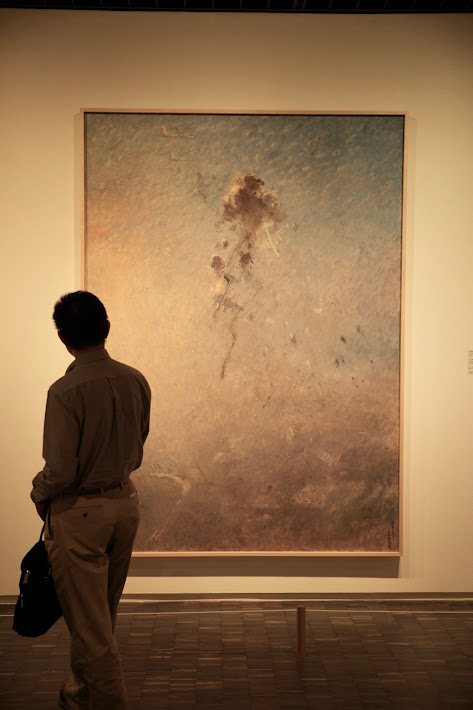
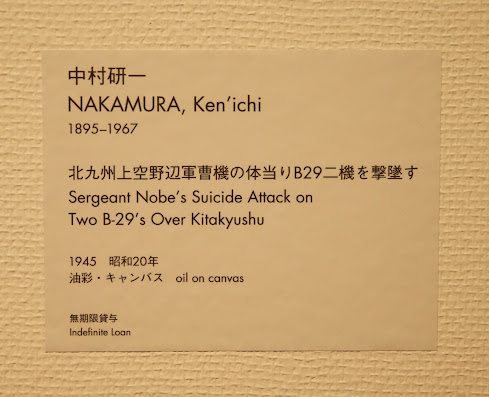
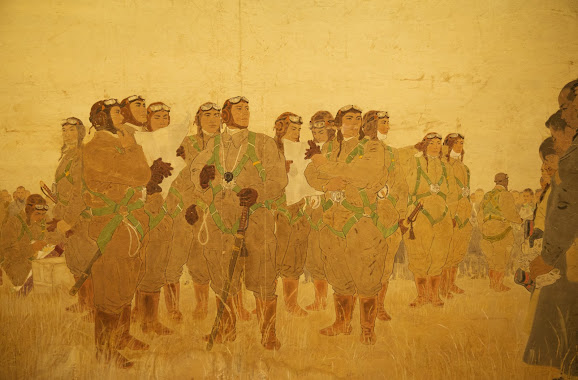
Nakamura, Ken'chi, war painter, and the wounds of a generation


I cannot remember where I saw these pictures, or which city even, was it Tokyo or Osaka, the Bridgestone Museum, or the Tokyo National museum? But anyway, and despite the poor photos made with an old i-Phone, I was certainly moved by these paintings. They provoked in me lots of feelings. 

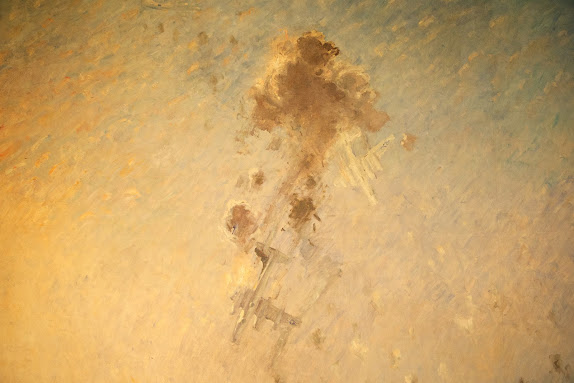
Done in a very Western style almost leads me to believe that the painter had studied abroad, USA or Europe? I remember thinking that it was an ambitious subject matter, one that depicted this iconic event in Japanese military history. As I have spent time with these paintings over the past few days they have elicited long buried memories from my childhood because photos of the war littered our house. They were scattered everywhere, in our bookshelves and desktops, coffee tables and piano tops, and  making it feel, through a child's eyes, as if we lived in a black and white cemetery. Our mother, who had joined the Red Cross in Italy, hugs a soldier, one of many phantom photos of phantom people from a phantom and unreal time before my birth. Also too, there were photos of the young and handsome, the beautiful and the glamorous to a degree, and they seemed to live in the permanent glow of a party full of gaiety on the eve of World War Two.

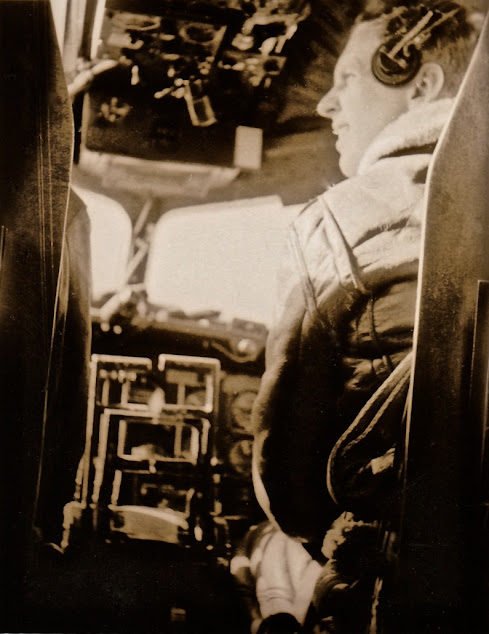
But this painting as the title states is about a crash taking place at high altitude over Japan. One of the planes, the B-29-15 BW "Calamity Jane" was assigned to to the 20th Air Force, 468th Bombardment Group at Pengshan Airfield in China. It took off on the 20th of August 1944 piloted by Captain Cornell Stauffer on a bombing run against the Yawata Steel Works on KyÅ«shu island in Japan. Over the target this bomber was flying no. 4 position of a four bomber diamond formation. On the bomb run while releasing their bombs, a Japanese fighter Ki-45 Nick piloted by Sgt Shigeo Nobe rammed the lead bomber B-29 "Gertrude C" 42-6334 head on. A piece of the wreckage struck the the tail stabiliser of "Calamity Jane" in fourth position, shearing it off and causing the bomber to enter a spin and crash. Nobe's attack was the first deliberate ramming of B-29's over Japan. "Gertrude C" was obviously destroyed immediately by the fighter plane.

Four of the crew on "Calamity Jane" who survived had bailed out from the nose wheel door, the rest of the crew and pilot presumed dead. Out of the eleven crew, four survived and were captured, then interned at the Omori POW Camp near Tokyo. They were liberated after the surrender. Then Nakamura painted this epic air battle in 1945 barely one year later.

Most of us now forget this generation of heroes who climbed aboard these bombers. Indeed those lost in WW2 from all countries everywhere, both 'victors' and vanquished, perished alongside civilians, refugees, all the animals, large and small, horses by the millions, the pets, all the cats and dogs, but the homes too, and the churches and the farms alike, the artworks, along with everyone's personals. In war, no one wins despite what your leaders tell you.

Both Germany and Japan quickly became allies after all that! Of course they should be allies, but why all the destructive fuss in the first place?.... a reasonable person queries. 

I have been to Normandy a few times over the years, arriving at Dieppe from Newhaven in the UK or vice-versa. I loved taking the boat back and forth across the Channel between these two great nations, themselves at war with one another for centuries. My regret is not finding my way to the headstone of my Uncle Angus MacDonell who was a B-17 pilot and flew several raids in Germany before perishing over the sea. They never found the bodies of the crew nor the plane. They were listed like so many in the war as KIA (killed in action). But apparently, our uncle and the crew had reached the sea only to then disappear. How? Where? our grandmother and mother would ask themselves relentlessly thereafter. 

Most of these B-17's on bombing runs were shot down and crashed in Germany after being pummelled by fighters. The attrition rate for these raids from Britain into Germany was about about 40%. These pilots knew it but flew anyway out of duty, and hoping to be an exception to this statistic.

I think I never made attempt to locate his headstone because I had forgotten that he was lost over the Channel during the war. Wrapped up in my life I had forgotten this "Great Generation" as they are called and remembered, still venerated by the last veterans and their families. But like me, most Americans don't remember them. And this means that we will certainly still again go to war for small reasons, or none at all.

But, I have promised myself that the next time I get over to Normandy I will find this lost uncle's headstone. Like for so many other families in that time his death shattered our family. The wounds lingered on, infecting everyone, and disabling my mother's sanity. 


our uncle, Captain Angus MacDonell in his B-17


07 February 2022

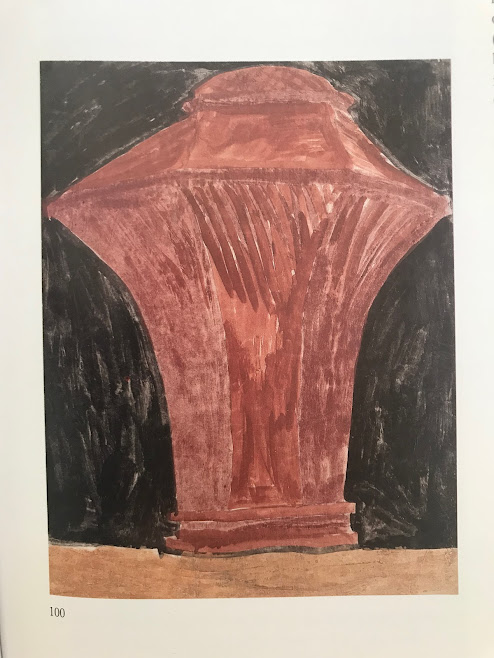
Duncan Grant and a pillar of Abstraction


Here is another one of these orphan images which slink around my desktop in search of a home. If my memory is still solvent I am 99% sure that it's by Duncan Grant of the Bloomsbury crowd, and I think it came from one of the books I have about these remarkably talented and eccentric Brits. I like to look at it sometimes which is one of the main reasons that all my desktops are cluttered with images. My screens look like teenager's bedrooms.

This image above I believe is a gouache and perhaps a study of a stone sculpture which one might see around the gardens at Bloomsbury. The main house which is quite small in fact, with very low ceilings and not a lot of natural light is surrounded by a myriad of old red brick walls with many artistic additions here and there which always surprise the visitor. This gouache looks to be like something which might have been resting atop one of the many  brick walls zigzagging the gardens. 

I like it for its pure sensuality and the tactile emotional imprint, qualities achievable with gouache in the right hands. It is an image of an ornament but also for me, it is just a pure piece of abstraction. These muted colours also lend themselves to a somewhat primitive sort of application which indicates that this was painted by a poet, not a technician. The colours feel almost archaic; a broken black lifted from Pompeii and two Sienese favourites; red and salmon, as if chipped off an old villa.   

I love that it just exists in space expressed easily without too much thought. An idea put forth visually, but then too, as if were were no rhyme or reason for it. And for me, it truly feels like a an abstract work done for pure pleasure. It possesses self-expression but without the pretension of it. And even upside down it is remarkably intact.


06 February 2022

Andrea Mantegna, Matisse and Modernism (yet again)


So this is a re-print which I indulge in once in a while because I come across older posts which seem to speak to me in my current mind set (forgive my indulgence).

l'air de rien

02 September 2019

Andrea Mantegna, Matisse and Modernism


The magnificent Humanity of Mantegna and Matisse is alive and well in these images. Separated by 400 years, these two artists share an interest in depicting a full range of the human soul. What is lacking in sophistication in the last portrait (of Marguerite) is made up for in the simplicity of its expression. And, Mantegna is a hard act to follow, a bit like any popular band going on stage to perform after the Rolling Stones. But, it is through expressive means that paintings are bound to greatness despite the technique employed. And, Painting is about making visual decisions at every moment in the creative process.

I saw this small portrait of a young man (in pink) at the Capodimonte Museum in Naples many years ago. It was so small, and it was placed on such a large wall in a palatial room surrounded by so many great pictures by Titian that one could have easily not noticed it at all. But its presence was undeniable, like a beautiful child at a funeral procession. 

The modernity of Matisse's flat graphic space isn't new. It is but part of the curved arc of progression in Painting which returns always back to a graphic unity. I think of Giotto, from whom escaped Mantegna, and his training as a Renaissance painter. Giotto, who singlehandedly, had carried us out of the Byzantine and into the world of a truly Modern 14th century. It begs the question? What is the next step in Painting? Can we reel Post-Modernism back to an expression of Humanity?


31 January 2022

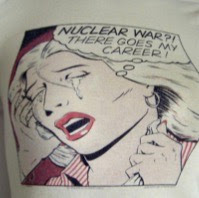
The Uninhabitable Earth, the unbearable brightness of seeing


                                                  Roy Liechtenstein, 1960's

I have been reading The Uninhabitable Earth, a dystopian assessment of a future life here on earth by David Wallis-Ellis. Honestly, living through all this information feels not only like being drowned into a dark funnel of hopelessness but also like being attacked by ten thousand Asian hornets at once. So why read it? Because I am fascinated by history, all kinds of histories about nations, cultures and people. But this feels like reading a history book about a place (our planet Earth) but in reverse, because most of it hasn't yet happened. Though we are already experiencing the planet's revolt at our behaviour, the worst is yet to come, increasingly within a hundred years time according to this author and many many others.

To be honest, I am actually listening to it in Audible which is a first for me. I am glad too, because it seems less lonely hearing the author's gentle voice describe the horrors just down the road. Reading it, on the other hand, alone in my dread, and creasing the book's poor paper pages with dog ears as I habitually do, might, I fear be too shattering and leave me in fetal position for days on end. Yes, I dramatise, but hey! This is serious shit, as the kids say these days.  

Would I recommend it? I am not sure because I have been sleeping badly now for a week. My heart seems to be revved up several hundred RPM like a two cylinder Yahama trail bike, and I awaken in the morning with that lost feeling I sometimes used to have with a hangover. In fact, it was indirectly recommended to me by the fellow who wrote and directed Don't Look Up when he spoke of it in an interview with Ari Melber a few weeks back. He described it as the catalyst for writing the screenplay. For him it was THE metaphor for climate change.

So, regarding Climate Change, I am not sure I would recommend it to anyone who wishes to maintain a fairytale version of how everything should, and will work out in the end. When an Aussie says to me (about anything) 

"She'll be right mate"

I know to run for the hills.

But, I am older, and thus will not see the more unpleasant changes coming to us all relatively soon. Though I am a pessimist by nature, not willingly, but out of an early childhood habit, it's confusing enough to face my own eventual demise, but the surreal prognosis of Earth's rapid transformation is mind-bending. It renders everything, well,,, just mute, silent like deep space.

Politically, it's my feeling that most deniers of Climate Change, (even surrogates of the fossil fuel industry) have basically surrendered the fight to save Earth. The smarter ones see it but deny its seriousness because basically they have surmised that it's inevitable, and it surpasses their imagination for any solutions, so they have given up. And for the dumber ones like Trump, this simply bypasses their own insular circuitry. But in the end, most of them are all hoping for the best while a few of the delusional wing (with money) still hope to get to Mars in time. But the really wealthy are all building fortresses in the mountains of Idaho and the Swiss Alps so to mitigate the consequences of it all. Most problems the rest of us have are a mere inconvenience for the truly Rich. But even they, with their deep pockets, cannot envision anything beyond their children's children's children's lives. For them, spreadsheets don't spread that far. 

Imagine Van Gogh's Starry Night ending up as a slide show in an underground luxury bunker in Idaho?

But lastly, I cannot get the ludicrous idea that Putin will probably wage war in Ukraine within weeks possibly, as if that is really so important? Mind you, the Idiot Bush Jr. also waged a senseless war twenty years ago and wreaking havoc for no apparent reason at all. But knowing that this planet has stage four cancer makes one want to stand up atop the dinner table, naked if need be, and scold all these people while brandishing celery stalks in their faces. 

Being bombarded with crisscrossing world events that distract us from the real existential crisis raises everything to a heightened surreality. And this is perfectly rendered in the marvellous black comedy Don't Look Up.

Here is what is still on offer on earth here at sea level. These were done in the past week at the beach.


Evening Prayer Brunswick Heads 28 January 2022, oil on canvas board, 30 X 25 cm


Evening Prayer Brunswick Heads 23 January 2022, oil on canvas board, 30 X 25 cm